Geological heritage

Discover books, audio and videos about Ecuador’s diversity.

Ecuador’s geodiversity

What is geological heritage?

Geological heritage includes areas of great scientific, educational and cultural value that bring together the elements that make up geodiversity, such as the variety, arrangement and shape of rocks, sediments, minerals and fossils. This geological diversity stands out in geosites: places of public interest that provide valuable information for better understanding natural resources, groundwater, natural hazards, environmental and climate change, and the evolution of life.

In Ecuador, a country of great geological diversity, these geosites are especially important. From the active volcanoes of the Andes to the sedimentary basins of the Amazon and the marine formations on the coast, these places help us understand phenomena that have shaped the Earth over millions of years.

Mascota de GeoGuardianes

GeoGuardianes

Ready to become a GeoGuardian? Learn about rocks, volcanoes and the Earth in a fun way.

Publications on Ecuador’s geological heritage

Read the books online or download them. Below each book you will find the flyovers and stories mentioned in its pages.

LIG Volume 1

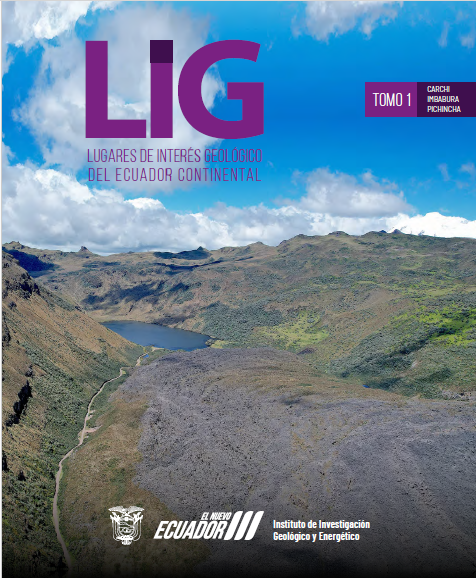
Lugares de Interés Geológico del Ecuador Continental, Tomo 1

Provinces of Carchi, Imbabura and Pichincha

The book "Lugares de Interés Geológico del Ecuador Continental, Tomo 1" presents the results of the project "Identification of Geological Heritage in Ecuador", focusing on the provinces of Carchi, Imbabura and Pichincha. It describes 25 geosites (LIG), classified by their stratigraphic, mineralogical, paleontological and hydrogeological interest, among others.

Includes 8 videos and 2 audios (flyovers, stories and testimonies) that play as you read.

Read more about this book

Geology is the study of the Earth and its evolution over time, and it includes areas such as geodiversity and geological heritage. Geodiversity refers to the variety of geological elements, such as rocks, minerals, fossils and landscapes, that reflect the planet’s evolution. Geological heritage, in turn, includes natural resources of scientific, cultural and educational value that help us understand the origin and processes of the Earth and the evolution of life.

Places of Geological Interest (LIG, from the Spanish acronym) are areas of scientific, educational or tourist importance that allow us to study and interpret geological history at a local, regional or global level. Since 2022, the Instituto de Investigación Geológico y Energético (IIGE) has carried out the project “Identification of Geological Heritage in Ecuador”, aimed at identifying and assessing the places of greatest geological value in the country.

The book "Lugares de Interés Geológico del Ecuador Continental, Tomo 1" presents the results of this project, focusing on the provinces of Carchi, Imbabura and Pichincha. It describes 25 LIG, classified by their stratigraphic, mineralogical, paleontological and hydrogeological interest, among others. It also includes a scientific, educational and tourist assessment of these places, as well as their susceptibility to and risk of degradation, providing a key tool for sharing IIGE’s knowledge of Ecuador’s geological heritage.
LIG Volume 2

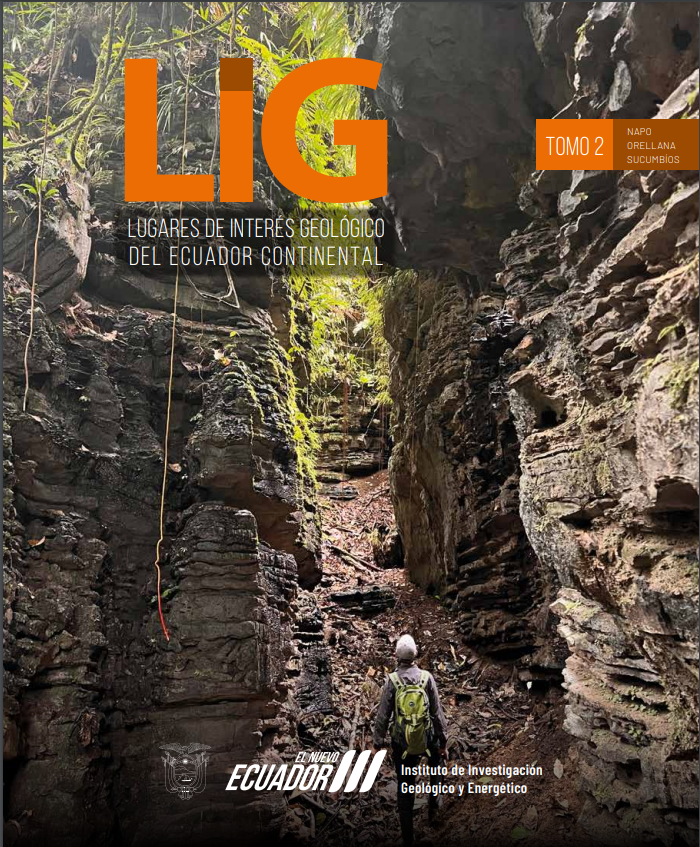
Lugares de Interés Geológico del Ecuador Continental, Tomo 2

Provinces of Napo, Orellana and Sucumbíos

The provinces of Napo, Orellana and Sucumbíos, in Ecuador’s Amazon region, stand out for their natural and geological richness.

Includes 10 videos (flyovers, stories and testimonies) that play as you read.

Read more about this book

The provinces of Napo, Orellana and Sucumbíos, in Ecuador’s Amazon region, stand out for their natural and geological richness. Napo, dominated by the Cordillera Real and the Sub-Andean Zone, shows an abrupt transition between mountains and alluvial plains, where geological phenomena such as volcanism and tectonic activity have shaped the landscape. The isolated and biodiverse Sumaco volcano is a highlight.

Orellana, southeast of Napo, is characterized by a vast river network, where the Napo and Coca rivers have carved terraces and meanders that illustrate the region’s sedimentary processes. In addition, hydrocarbons in the subsoil have driven oil exploration, adding an economic dimension to its geological interest.

Sucumbíos, to the north, is home to the Oriente Basin, a major sedimentary basin with rich biodiversity and fossil resources. Outcrops of sedimentary rocks and tectonic structures make it possible to study the area’s geological history, revealing layers of sediment accumulated over millions of years, evidence of ancient seas and rivers.

These provinces also offer opportunities for geological ecotourism, where visitors can explore caves, rock formations and landscapes shaped by geological processes. Responsible tourism not only promotes knowledge but also supports the conservation of these fragile and unique environments.